
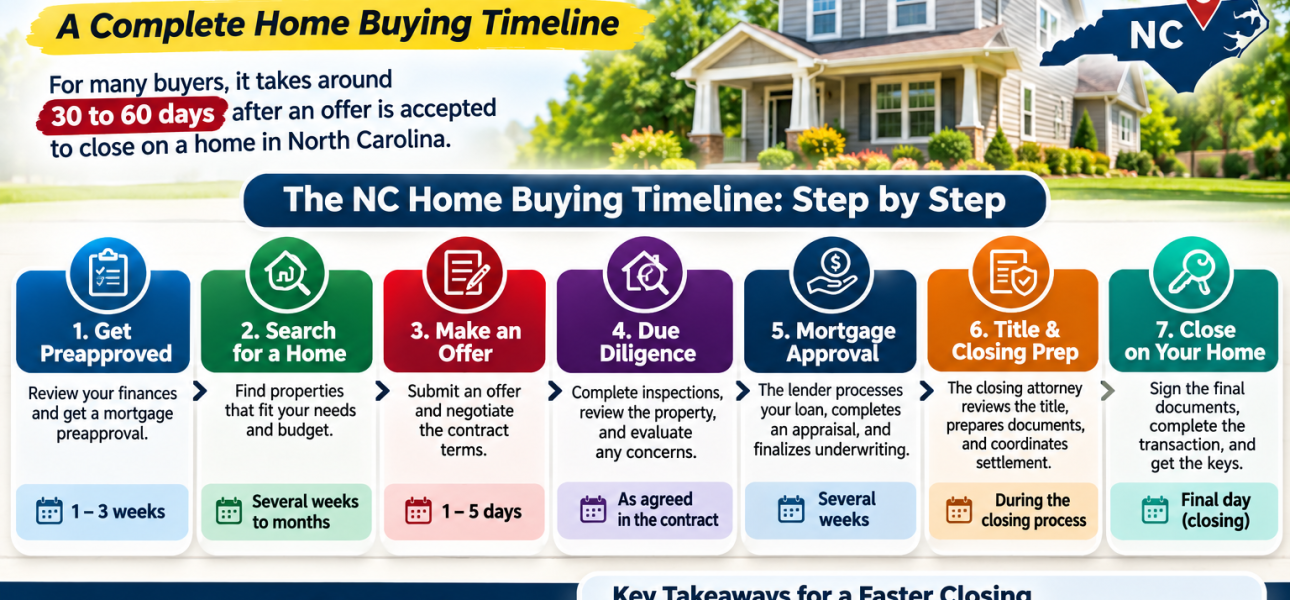
Buying a home is exciting, but it also involves several steps that take time. From getting mortgage preapproval to finding the right property, negotiating an offer, completing inspections, and signing the final paperwork, the process rarely happens overnight.
So, how long does it take to buy a house in NC?
For many buyers, the process takes around 30 to 60 days after an offer is accepted, depending on the mortgage, property condition, contract terms, and closing arrangements. However, the full journey can take longer because you may spend several weeks or months preparing financially and searching for a home before making an offer.
Understanding the NC home buying timeline helps you plan ahead, avoid unnecessary delays, and know what to expect at each stage.
In this guide, we explain the typical buying house timeline in NC, from your first mortgage conversation to receiving the keys.
How Long Does It Take to Buy a House in NC?
A typical financed home purchase in North Carolina may take approximately 30 to 60 days from an accepted offer to closing. The preparation and home search stages happen before that and can add several weeks or months.
Here is a general overview:
| Home-buying stage | Estimated time |
| Financial preparation and mortgage preapproval | 1–3 weeks |
| Searching for a home | Several weeks to several months |
| Making an offer and negotiating | 1–5 days, sometimes longer |
| Due diligence and inspections | Based on the agreed contract period |
| Mortgage processing and underwriting | Often several weeks |
| Appraisal and title work | Usually completed during the closing process |
| Final walkthrough and closing | Final days before settlement |
These are planning estimates rather than guaranteed deadlines. Some activities happen at the same time. For example, your lender may begin processing the mortgage while you arrange inspections and the closing attorney reviews the title.
According to ICE Mortgage Technology’s May 2026 Mortgage Monitor, the average purchase mortgage closed in 36.8 days in March 2026, measured from loan application to closing. This is a national mortgage-processing benchmark, not a North Carolina-specific guarantee or a measure of the entire home search.
Step 1: Prepare Your Finances and Get Mortgage Preapproval
Estimated time: 1–3 weeks
Before searching seriously for a home, understand how much you can comfortably afford.
Start by reviewing your:
- Monthly income.
- Existing debts and financial obligations.
- Credit history and credit score.
- Available savings.
- Expected down payment.
- Estimated closing costs.
Next, speak with a mortgage lender about preapproval. A mortgage preapproval gives you an estimate of how much a lender may be willing to finance based on an initial review of your financial information. It is not a final loan approval, but it helps establish a realistic buying budget.
What Documents Do You Need for Mortgage Preapproval?
Your lender may request:
- Recent pay stubs.
- W-2 forms or tax returns.
- Bank statements.
- Identification.
- Employment information.
- Details of existing debts.
If you are self-employed, the lender may request additional income and business documentation.
Practical tip: Avoid taking on new debt or making large unexplained deposits while preparing for a mortgage. These changes can create additional questions during underwriting.
Getting preapproved before making an offer can also help you act more confidently when you find a suitable property.
Step 2: Search for a Home in North Carolina
Estimated time: Several weeks to several months
Once you understand your budget, you can begin exploring available properties. The time needed to find a home depends on your requirements, location, budget, and current inventory.
For example, a buyer looking for a three-bedroom home in Charlotte may have different options from someone searching for a larger property in Waxhaw or Weddington.
Before starting your search, identify your priorities.
Consider:
- Preferred cities and neighborhoods.
- Number of bedrooms and bathrooms.
- Property type.
- School and commute considerations.
- Access to shopping and other amenities.
- Maximum purchase price.
- Desired home features.
Separate essential requirements from features you would simply like to have. This can make it easier to compare properties without extending your search unnecessarily.
How Can You Make Your Home Search Faster?
You can make your search more efficient by:
- Setting a realistic budget before viewing properties.
- Choosing a few preferred locations.
- Getting mortgage preapproval early.
- Reviewing property details before scheduling showings.
- Staying open to suitable alternatives.
- Working with a real estate professional who understands your preferred market.
Mike Koman Realty can help buyers explore available properties and communities across Charlotte and surrounding areas.
You can start by visiting the property search website to explore available homes.
Step 3: Make an Offer and Negotiate the Contract
Estimated time: 1–5 days, sometimes longer
When you find a property you want to purchase, the next step is submitting an offer.
Your offer generally includes:
- Proposed purchase price.
- Earnest money amount.
- Due diligence fee, if offered.
- Due diligence period.
- Proposed settlement date.
- Financing terms.
- Other requested conditions and provisions.
The seller can accept, reject, or make a counteroffer. For example, imagine you find a home in Indian Trail listed for $375,000. You submit an offer with a proposed purchase price of $365,000.
The seller may accept the offer or respond with a different price or contract terms. You may then negotiate until both parties agree.
Once the contract is signed by the required parties and becomes effective, the contractual deadlines begin.
What Are Earnest Money and Due Diligence Fees?
North Carolina has two important payments buyers should understand.
Earnest money is a deposit that demonstrates your commitment to the purchase. It is generally held by an agreed escrow agent.
The due diligence fee is a negotiated payment made to the seller in exchange for the buyer’s contractual due diligence rights.
Under the commonly used North Carolina purchase contract, earnest money is generally refundable when the buyer properly terminates during the agreed due diligence period. The due diligence fee is generally nonrefundable, subject to specific contract exceptions.
Read our detailed guide to earnest money vs due diligence fee in NC to understand how these payments work.
Step 4: Complete the Due Diligence Process
Estimated time: Determined by the contract
The due diligence period is an important part of the North Carolina home-buying timeline. It gives you an agreed period to investigate the property and decide whether to proceed with the purchase.
There is no universal due diligence period that applies to every transaction. The buyer and seller negotiate the length of this period.
During this time, you may:
- Arrange a professional home inspection.
- Review the roof, foundation, plumbing, and electrical systems.
- Investigate potential water damage or pest issues.
- Review homeowners association documents.
- Check insurance availability and costs.
- Investigate septic systems or wells when applicable.
- Discuss inspection findings and possible repairs.
- Continue working with your lender.
Why Should You Complete Inspections Early?
Imagine you are buying a home in Matthews. Your home inspection identifies signs of moisture around the foundation.
You may need additional evaluation to understand the cause and possible repair expenses. Scheduling the inspection early gives you more time to investigate and discuss your options before the due diligence deadline.
If you wait until the final days, you may have limited time to arrange specialist inspections or negotiate with the seller.
Practical tip: Schedule your inspections as soon as the contract becomes effective. Do not assume the due diligence period will automatically be extended if an inspection takes longer than expected.
Step 5: Complete the Mortgage Appraisal and Underwriting
Estimated time: Several weeks, often overlapping with due diligence
While you investigate the property, your lender continues processing your mortgage. Two important activities are the appraisal and underwriting.
What Is a Home Appraisal?
An appraisal is an independent estimate of the property’s market value. Your lender generally orders it to evaluate whether the property provides sufficient collateral for the mortgage.
For example, if you agree to purchase a home for $400,000 but the appraisal comes in at $380,000, your lender may need to review the difference.
Depending on your loan terms and contract, you may need to discuss the appraisal with your lender and real estate professional to understand your options.
What Happens During Mortgage Underwriting?
Underwriting is the process where the lender reviews your financial information and the property details to determine whether the loan meets its requirements.
The underwriter may review:
- Income and employment.
- Credit history.
- Debt-to-income ratio.
- Bank statements and available funds.
- Property appraisal.
- Title and other required documentation.
The lender may request additional documents before issuing final approval. Responding quickly to these requests can help prevent unnecessary delays.
Important: Mortgage preapproval does not guarantee final loan approval. Continue providing accurate information and avoid major financial changes before closing.
Step 6: Complete the Title Search and Closing Preparation
Estimated time: Usually handled during the weeks before closing
North Carolina home purchases commonly involve a closing attorney who handles important legal and settlement work.
The closing attorney may coordinate:
- Title examination.
- Preparation of closing documents.
- Review of ownership records.
- Coordination with the lender.
- Preparation of the settlement statement.
- Collection and distribution of closing funds.
- Recording the required documents.
A title search helps identify ownership issues, liens, and other matters that may affect the property.
If a title issue needs to be resolved, the closing process may take longer. You should also arrange homeowners insurance and confirm your final cash-to-close amount with your lender and closing attorney.
Step 7: Complete the Final Walkthrough and Close on Your Home
Estimated time: Final few days before settlement
You are almost at the finish line. Before closing, you will generally have an opportunity to complete a final walkthrough of the property.
The purpose is to confirm that the home is in the expected condition and that agreed repairs or other contractual requirements have been addressed.
Check:
- Whether the property is in the agreed condition.
- Whether agreed repairs have been completed.
- Whether included appliances and fixtures remain.
- Whether the home is vacant if required by the contract.
- Whether there are any new visible issues.
What Happens on Closing Day in NC?
At closing, you will review and sign the required documents, provide any remaining funds, and complete the final steps of the transaction.
Your closing attorney coordinates the settlement and recording process.
Once the transaction is completed and the necessary requirements are satisfied, you can receive the keys according to the contract and closing arrangements.
Congratulations! You are now a homeowner.
What Can Delay the NC Home Buying Timeline?
Even when everyone wants to close on time, unexpected issues can affect the schedule.
Common causes of delays include:
1. Mortgage Documentation Issues
Missing documents, inconsistent income information, or unexplained bank deposits can create additional underwriting requests.
2. Low Property Appraisal
If the appraisal is below the agreed purchase price, the buyer, seller, and lender may need to review available options.
3. Inspection Problems
Significant structural, plumbing, roofing, or other property concerns may lead to further investigations and negotiations.
4. Title Issues
Unresolved liens, ownership questions, or recording problems can delay closing.
5. Slow Communication
A delayed response from a buyer, seller, lender, insurance provider, or closing attorney can affect the overall schedule.
6. Changes in Financial Circumstances
Changing jobs, opening new credit accounts, or making large purchases during the mortgage process may require additional lender review.
The best way to reduce these risks is to stay organized, respond quickly, and communicate with the professionals involved in your transaction.
How Can You Make Buying a House in NC Faster?
You cannot control every part of the process, but you can take steps to avoid preventable delays.
Here are six practical tips:
- Get preapproved early: Understand your financing options before making an offer.
- Prepare your documents: Keep income, bank, and employment records ready.
- Choose your preferred locations: Avoid restarting your search because your requirements are unclear.
- Schedule inspections quickly: Use the due diligence period effectively.
- Respond to lender requests: Send requested documents as soon as possible.
- Stay in contact with your real estate professional: Keep track of contract deadlines and upcoming requirements.
A well-prepared buyer can often make the transaction smoother, even when unexpected issues arise.
Frequently Asked Questions
1. How long does it take to buy a house in NC after an offer is accepted?
Many financed purchases take approximately 30 to 60 days from an accepted offer to closing. The actual timeline depends on mortgage approval, appraisal, inspections, title work, and the settlement date agreed upon in the contract.
2. Can I buy a house in North Carolina in 30 days?
Yes. A 30-day closing can be possible when the buyer is financially prepared, the lender processes the mortgage on time, the appraisal and title work are completed, and there are no major property or contract issues. It is not guaranteed.
3. How long does mortgage approval take in North Carolina?
Mortgage processing timelines vary by lender and borrower. ICE Mortgage Technology reported an average of 36.8 days from application to closing for purchase loans in March 2026. This includes more than underwriting alone. A complete application and prompt responses to lender requests can help avoid delays.
4. Does the due diligence period affect the closing timeline in NC?
Yes. The due diligence period determines how long the buyer has to investigate the property and exercise the contractual right to terminate under the applicable contract. Its length is negotiated between the buyer and seller. It can affect when the buyer makes a final decision about proceeding, but it is not the same as the full closing period.
Conclusion
So, how long does it take to buy a house in NC? For many buyers, the process takes around 30 to 60 days after an offer is accepted. However, the complete journey can take longer when you include financial preparation and the time needed to find the right property.
The best way to prepare is to understand each stage before making an offer. Get mortgage preapproval, choose your preferred communities, understand the due diligence period, and stay in contact with your lender and real estate professional.
If you are planning to buy a home in Charlotte or a nearby North Carolina community, Mike Koman Realty can help you explore available properties and navigate the home-buying process.
Browse available homes or contact Mike Koman Realty to discuss your plans.
Also Read: How Much Money Do Need to Buy a House in NC