
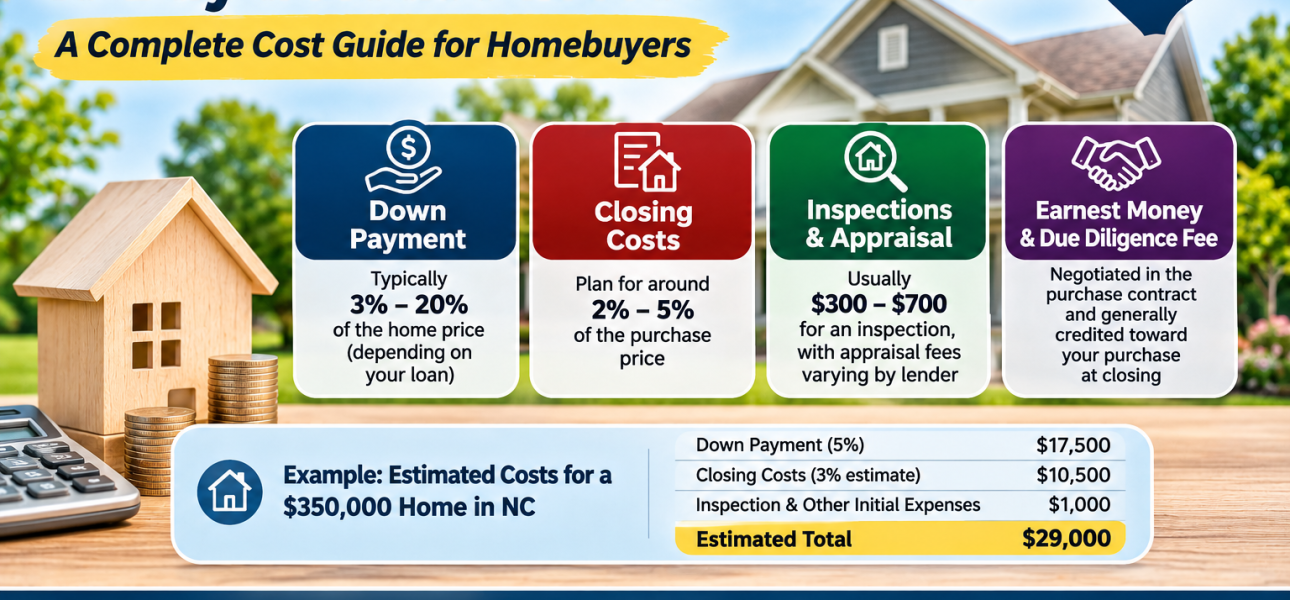
Buying a house in North Carolina can be more affordable than many buyers expect, but the down payment is only one part of the money you need. You should also plan for closing costs, inspections, earnest money, the due diligence fee, and other expenses that come with purchasing a property.
So, how much money do I need to buy a house in NC?
The answer depends on the home’s purchase price, your mortgage program, credit profile, and the terms you negotiate with the seller. Some buyers may qualify for a mortgage with a down payment as low as 3% or even 0% through eligible loan programs. However, you still need to prepare for other upfront costs.
This guide breaks down the major home-buying costs in North Carolina, provides realistic examples, and explains how to estimate the savings you may need before making an offer.
How Much Money Do You Need to Buy a House in NC?
The amount you need depends on your down payment, closing costs, prepaid expenses, and contract-related payments.
As a starting point, many buyers should plan for:
- Down payment: Often between 3% and 20% of the purchase price, depending on the loan.
- Closing costs: A broad planning estimate is around 2% to 5% of the purchase price.
- Inspection and appraisal expenses: Vary based on the property and lender.
- Earnest money and due diligence fee: Negotiated in the purchase contract.
- Moving and initial home expenses: Depend on your plans and the condition of the property.
These amounts do not all represent additional costs. For example, earnest money and the due diligence fee are generally credited toward your purchase at closing according to the contract. Your lender should help you understand how much cash you need to bring to closing.
Down Payment in NC: How Much Should You Save?
Your down payment is the portion of the home’s purchase price that you pay upfront instead of borrowing from a mortgage lender.
A common misconception is that you must save 20% before buying a home. That is not always true.
Several mortgage programs allow qualified buyers to purchase a home with a smaller down payment.
Common Down Payment Options
| Mortgage type | Typical minimum down payment |
| Conventional loan | As low as 3% for eligible borrowers and programs |
| FHA loan | 3.5% for borrowers who meet credit requirements |
| VA loan | 0% for eligible borrowers |
| USDA loan | 0% for eligible properties and borrowers |
Actual eligibility depends on your credit, income, debt, property, lender requirements, and loan program. Some conventional programs also have first-time buyer or income restrictions.
Down Payment Examples in North Carolina
Consider a home priced at $350,000.
| Down payment percentage | Amount you need |
| 3% | $10,500 |
| 3.5% | $12,250 |
| 5% | $17,500 |
| 10% | $35,000 |
| 20% | $70,000 |
A smaller down payment can make homeownership more accessible. However, it may increase your monthly mortgage payment and could require private mortgage insurance on a conventional loan.
A 20% down payment may help you avoid private mortgage insurance on many conventional loans, but it is not a universal requirement for buying a home.
Closing Costs in NC: What Should You Budget?
Closing costs are the fees and expenses you pay to complete your home purchase. These are separate from your down payment.
According to the North Carolina Housing Finance Agency, buyers can use a broad estimate of 2% to 5% of the purchase price when planning for closing costs. The actual amount depends on the property, lender, loan program, and transaction.
Common closing costs include:
- Loan origination fees: Charges for processing and preparing your mortgage.
- Appraisal fees: The cost of estimating the property’s market value for the lender.
- Attorney fees: Charges for legal services and closing-related work.
- Title search and title insurance: Expenses related to reviewing ownership records and protecting against covered title issues.
- Recording fees: Charges for recording documents with the appropriate county office.
- Prepaid property taxes: Amounts collected in advance when required.
- Homeowners insurance: Premiums that may need to be paid before closing.
- Prepaid interest: Interest that accrues between closing and the start of your regular mortgage payment schedule.
How Much Are Closing Costs on a $350,000 Home?
Using the broad 2% to 5% planning range:
| Estimated percentage | Estimated closing costs |
| 2% | $7,000 |
| 3% | $10,500 |
| 4% | $14,000 |
| 5% | $17,500 |
These are budgeting estimates, not a quote for a specific property. For a realistic figure, ask your lender for a Loan Estimate. Review the fees and compare them with your final Closing Disclosure before closing.
Earnest Money and Due Diligence Fee
When buying a house in North Carolina, you may need to make two payments after your offer is accepted: earnest money and a due diligence fee.
Although both are paid near the beginning of the transaction, they serve different purposes.
What Is Earnest Money?
Earnest money is a deposit that demonstrates your commitment to purchasing the property. It is generally held by an agreed escrow agent.
If the transaction closes, the deposit is typically credited toward the amount you owe.
Under the commonly used North Carolina purchase contract, earnest money is generally refundable if you properly terminate during the agreed due diligence period. Other contract terms and circumstances can affect the outcome.
What Is a Due Diligence Fee?
A due diligence fee is a negotiated payment made to the seller in exchange for the buyer’s contractual right to investigate the property and decide whether to proceed during the agreed due diligence period.
Under the standard North Carolina contract, this fee is generally nonrefundable, subject to specific contractual exceptions. It is typically credited toward the purchase at closing.
Example of Upfront Contract Payments
Imagine you make an offer on a $350,000 home and agree to:
- Earnest money: $3,500
- Due diligence fee: $1,500
Your total initial contract payments would be $5,000.
However, this does not mean you need an additional $5,000 on top of your down payment and closing costs. These payments are generally credited toward your purchase at closing.
If you want to understand the refund rules in more detail, read our guide to earnest money vs due diligence fee in North Carolina.
Other Upfront Costs When Buying a House
Apart from your down payment and closing costs, there are several expenses you should consider before purchasing a property.
Home Inspection
A professional home inspection helps identify visible issues with the property.
The inspector may examine:
- Roof condition.
- Foundation and structural components.
- Plumbing systems.
- Electrical systems.
- Heating and cooling equipment.
- Doors and windows.
- Visible signs of water damage.
Depending on the property, you may also need specialized inspections for pests, septic systems, wells, or other concerns.
Home Appraisal
Your lender may require an appraisal to estimate the property’s market value. This helps the lender evaluate whether the home provides sufficient collateral for the mortgage.
An appraisal is different from a home inspection. An appraisal focuses on value, while an inspection focuses on the property’s condition.
Homeowners Insurance
Most mortgage lenders require homeowners insurance. You may need to arrange coverage before closing and pay an initial premium or escrow amount.
The premium can vary based on the home’s location, age, construction, coverage, and other risk factors.
Moving and Initial Home Expenses
Remember to budget for expenses after receiving the keys.
These may include:
- Moving company or rental truck.
- Utility deposits and setup fees.
- Cleaning and minor repairs.
- Furniture and appliances.
- Locks and security improvements.
- Lawn care and basic maintenance supplies.
A home purchase can use a large portion of your savings. Keeping some money available after closing can help you manage unexpected expenses.
Real Example: How Much Money Do You Need for a $350,000 Home in NC?
Let’s put the major expenses together.
Assume you are purchasing a $350,000 home with a conventional mortgage and a 5% down payment.
| Expense | Illustrative amount |
| Down payment (5%) | $17,500 |
| Closing costs (3% estimate) | $10,500 |
| Inspection and other initial expenses | $1,000 |
| Estimated total before credits or assistance | $29,000 |
This example gives you a starting budget. It is not a lender quote. The actual amount could be lower or higher depending on your loan, negotiated seller contributions, prepaid expenses, and assistance programs.
The earnest money and due diligence fee are not added again in this example because they are generally credited toward the purchase at closing. You should still have enough available to pay them when required by your contract.
Also remember that the $29,000 estimate does not include a separate emergency fund for unexpected repairs or ongoing homeownership expenses.
Down Payment Assistance Programs in North Carolina
If saving for a down payment is your biggest challenge, explore available assistance programs before delaying your home purchase.
The North Carolina Housing Finance Agency (NCHFA) offers programs that may help eligible buyers with upfront expenses.
NC Home Advantage Mortgage
The NC Home Advantage Mortgage program offers eligible first-time and move-up buyers down payment assistance of up to 3% of the loan amount.
According to NCHFA, general eligibility requirements include:
- Purchasing a home in North Carolina.
- Using the home as your principal residence.
- Meeting the applicable income and sales price limits.
- Having a credit score of at least 640.
- Qualifying for an eligible FHA, VA, USDA, or conventional mortgage through a participating lender.
NCHFA announced in June 2026 that the standard program’s income limit increased to $158,000 and the applicable sales price limit increased to $525,000.
NC 1st Home Advantage Down Payment
Eligible first-time buyers and military veterans may qualify for up to $15,000 in down payment assistance through the NC 1st Home Advantage Down Payment program.
The assistance is structured as a 0% deferred second mortgage. Under the program’s current terms, it is forgiven over years 11 through 15, with full forgiveness at the end of year 15. Selling, refinancing, or transferring the home before then can trigger repayment requirements.
Program rules and eligibility conditions apply. Check the official North Carolina Housing Finance Agency homebuyer programs and speak with a participating lender to confirm your eligibility.
Practical Ways to Reduce Your Home-Buying Costs
You do not always need to save a large amount before exploring homeownership. A few careful decisions can make a difference.
- Compare mortgage options: Ask lenders to explain conventional, FHA, VA, and USDA financing if you may qualify. Compare the interest rate, fees, monthly payment, and total loan costs.
- Check assistance programs early: Some programs have income, credit, property, and lender requirements. Find out whether you qualify before making an offer.
- Discuss seller concessions: Depending on the loan program and contract, a seller may agree to contribute toward certain buyer closing costs. These contributions have limits and are not guaranteed.
- Review your Loan Estimate: Compare lender fees, prepaid expenses, and other charges. Ask questions about anything you do not understand.
- Avoid spending all your savings: Keep funds available for moving, repairs, and unexpected expenses after closing.
- Choose a home that fits your monthly budget: Do not focus only on the amount a lender approves. Consider property taxes, insurance, utilities, maintenance, and other monthly commitments.
Conclusion
So, how much money do I need to buy a house in NC? There is no fixed amount for every buyer. Your savings requirement depends on the purchase price, down payment, closing costs, mortgage program, and contract terms.
Start by estimating your down payment and closing costs. Then account for inspections, earnest money, the due diligence fee, moving expenses, and a financial cushion after closing.
You may not need 20% down to become a homeowner. North Carolina also offers assistance programs that may help qualified buyers reduce their upfront financial burden.
If you are planning to purchase a property in Charlotte or a nearby North Carolina community, Mike Koman Realty can help you explore available homes and understand the steps involved in the buying process.
Browse available homes or contact Mike Koman Realty to discuss your home-buying plans.
Frequently Asked Questions
1. Can I buy a house in NC with $10,000?
It may be possible, depending on the purchase price, mortgage program, down payment assistance, seller contributions, and closing costs. Some eligible buyers can qualify for low or zero-down-payment financing. However, you should also account for inspections, contract payments, prepaid expenses, and cash needed at closing.
2. Is a 20% down payment required to buy a house in North Carolina?
No. Eligible buyers may qualify for conventional loans with down payments as low as 3%, FHA loans with 3.5% down, or VA and USDA loans with no down payment. Eligibility and other costs vary by program.
3. What credit score do I need to buy a house in NC?
There is no single credit score requirement for every mortgage. FHA, conventional, VA, and USDA loans have different requirements. Some NCHFA programs currently list a minimum credit score of 640, but individual lenders may apply additional standards.
4. Can I use down payment assistance to pay closing costs?
It depends on the program and loan structure. Some assistance programs may reduce the amount of your own money needed for the down payment, which can leave more savings available for closing expenses. Ask a participating lender which expenses the assistance can cover.
Alos Read: Closing Costs in North Carolina