
Buying a home in North Carolina involves more than choosing a property and agreeing on a purchase price. When your offer is accepted, you may need to pay two separate amounts: earnest money and a due diligence fee.
If you are a first-time buyer, these payments can be confusing. Both are paid near the beginning of the transaction, but they serve different purposes. More importantly, their refund rules are not the same.
Understanding earnest money vs due diligence fee NC can help you avoid costly surprises and make a more informed offer.
In this guide, we explain the meaning of each payment, how they work under a typical North Carolina purchase contract, when you can get your money back, and what to consider before making an offer.
What Is Earnest Money When Buying a House in North Carolina?
Earnest money is a deposit that shows a seller you are serious about purchasing their property. It is sometimes called an earnest money deposit or EMD.
When you make an offer on a home, you may agree to provide an earnest money deposit as part of the purchase contract. The money is generally held by an agreed escrow agent, such as a real estate firm or closing attorney, rather than being paid directly to the seller.
If the transaction successfully closes, the earnest money is typically credited toward the amount you owe at closing.
What Is the Purpose of Earnest Money?
Earnest money helps demonstrate that you intend to move forward with the purchase. It also gives the seller additional confidence when comparing offers.
For example, imagine you find a home in Charlotte listed for $400,000. You submit an offer and agree to provide $4,000 in earnest money.
This deposit shows the seller that you are making a financial commitment to the transaction. However, it does not automatically mean you will lose the money if something changes.
Under the commonly used North Carolina Offer to Purchase and Contract, properly terminating the agreement during the due diligence period generally allows the buyer to receive the earnest money deposit back.
Is Earnest Money Refundable in North Carolina?
Generally, yes, if you follow the contract’s termination requirements. Under the standard North Carolina Form 2-T, a buyer who properly terminates the contract during the agreed due diligence period is generally entitled to a refund of the earnest money deposit.
However, the outcome may be different if:
- You terminate the contract after the due diligence period without a valid contractual basis.
- You fail to meet an important contractual obligation.
- You do not follow the required termination procedure.
- The contract contains additional terms that affect the deposit.
If the parties disagree about who should receive the money, the escrow agent may need written authorization from the parties or a court order before releasing disputed funds. The key is to understand your contract before signing it.
What Is a Due Diligence Fee in North Carolina?
A due diligence fee is a negotiated payment made by the buyer to the seller in exchange for the buyer’s contractual right to investigate the property and decide whether to proceed during the agreed due diligence period.
This is one of the important features of residential real estate transactions in North Carolina.
The fee compensates the seller for allowing the buyer time to investigate the property while the seller is generally committed to the contract.
Unlike earnest money, the due diligence fee is generally paid directly to the seller. Under the standard Form 2-T, it becomes the seller’s property upon the contract’s effective date, subject to the exceptions stated in the contract.
What Does the Due Diligence Period Allow You to Do?
The due diligence period gives you time to investigate the home and the transaction before deciding whether to continue.
During this period, you may:
- Schedule a professional home inspection.
- Evaluate the roof, foundation, plumbing, and electrical systems.
- Review the property’s condition.
- Investigate potential environmental concerns.
- Review homeowners association documents when applicable.
- Confirm insurance availability and estimated costs.
- Work with your lender on financing and appraisal matters.
- Evaluate whether the property meets your needs.
For example, suppose you are buying a home in Marvin. During your inspection, you discover that the roof may need significant repairs.
You can discuss the findings with your real estate agent and decide whether to request repairs, negotiate different terms, or terminate the contract within the agreed due diligence period.
The seller is not automatically required to complete requested repairs. Any agreement about repairs or other changes should be documented properly.
Is the Due Diligence Fee Refundable?
Generally, no. Under the standard North Carolina Form 2-T, the due diligence fee is usually nonrefundable if the buyer decides to terminate the contract.
There are important exceptions. The contract provides for a refund in certain circumstances, including a material breach by the seller under the applicable provisions. Other contractual addenda may also affect the outcome.
If the transaction closes successfully, the due diligence fee is generally credited to the buyer at closing. This means it is accounted for as part of the buyer’s funds in the transaction rather than being an additional fee on top of the purchase price.
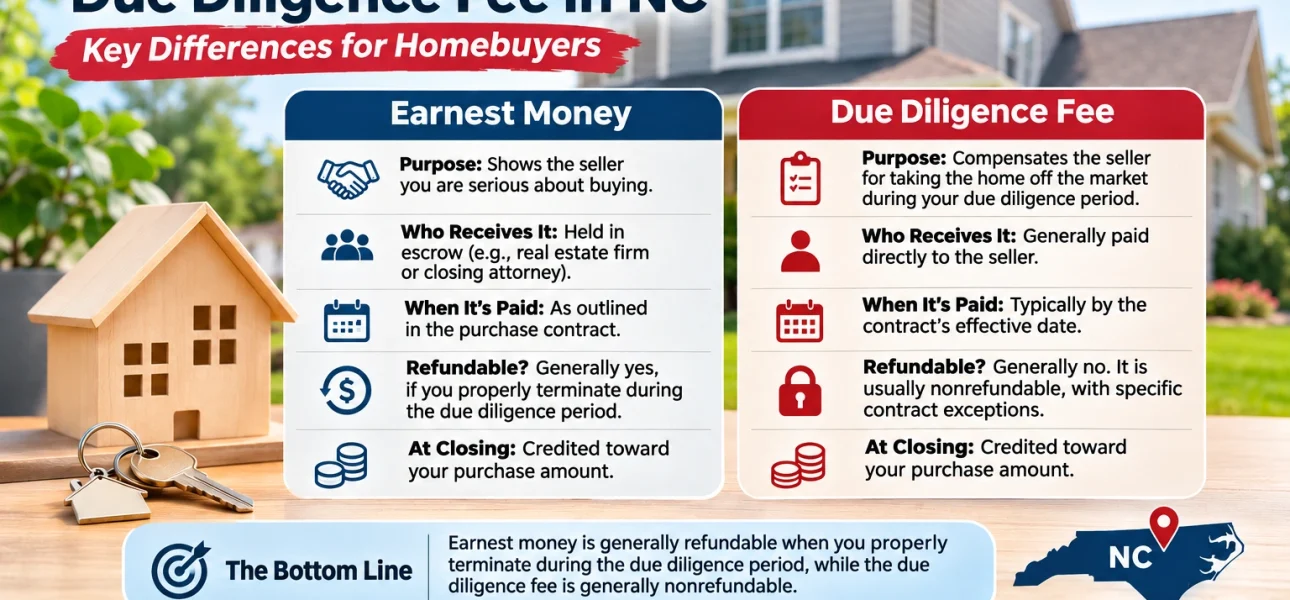
Earnest Money vs Due Diligence Fee NC: What Is the Difference?
Although both payments are connected to a home purchase, they have different purposes and refund rules.
| Feature | Earnest Money | Due Diligence Fee |
| Main purpose | Demonstrates the buyer’s commitment | Compensates the seller for the due diligence opportunity |
| Who receives it? | Agreed escrow agent | Generally the seller |
| When is it paid? | According to the contract | Generally by the contract’s effective date |
| Refund during due diligence period | Generally refundable after proper termination | Generally nonrefundable |
| If the transaction closes | Credited toward the buyer’s amount due | Credited toward the buyer’s amount due |
| Amount | Negotiated | Negotiated |
| Required in every transaction? | No | No |
The main difference: Earnest money is generally refundable when the buyer properly terminates during the due diligence period. The due diligence fee is generally not refundable because it compensates the seller for the buyer’s contractual right to investigate and terminate during that period.
How Much Earnest Money and Due Diligence Fee Should You Pay?
There is no single amount that every North Carolina buyer must pay. Both payments are negotiable. The appropriate amounts depend on the property, market conditions, seller expectations, offer terms, and your financial comfort.
For example, consider a hypothetical $400,000 home purchase:
| Payment | Example amount |
| Earnest money deposit | $4,000 |
| Due diligence fee | $2,000 |
| Total upfront payments | $6,000 |
These figures are only an illustration. They are not a recommended amount or a statewide average.
Before deciding what to offer, consider:
- Your available cash: Make sure you can comfortably afford the upfront payments without affecting your ability to cover inspections, closing costs, moving expenses, and other obligations.
- Local competition: In a competitive market, sellers may receive offers with different earnest money and due diligence amounts.
- Property condition: A home that requires further investigation may call for a careful approach to the due diligence period and fee.
- Your risk tolerance: Consider how much money you could afford to lose if you decide to terminate the contract and the due diligence fee is not refundable.
- Your financing situation: Speak with your lender about loan approval, appraisal timing, and the funds you will need before closing.
Do not offer more money simply because another buyer might. Your offer should reflect your financial position and the risks you are willing to accept.
What Happens If You Back Out of a Home Purchase in North Carolina?
Your financial outcome depends on when and why you terminate the contract and whether you follow the agreement.
Let’s look at three common situations.
Scenario 1: You Back Out During the Due Diligence Period
You purchase a home in Indian Trail and agree to a due diligence fee of $2,000 and earnest money of $4,000.
During the inspection, you discover significant water damage. After reviewing the findings, you decide the property is no longer suitable.
If you properly terminate the contract within the agreed due diligence period:
- You generally receive your $4,000 earnest money deposit back.
- You generally forfeit the $2,000 due diligence fee.
This is why buyers should complete their investigations before the due diligence deadline.
Scenario 2: You Back Out After the Due Diligence Period
Suppose your due diligence period ends, but you later decide you no longer want the home because you found another property.
You may no longer have the same unrestricted termination right provided during the due diligence period.
If you terminate without a valid contractual basis, you may risk losing your earnest money and due diligence fee. The seller’s remedies will depend on the contract and applicable law. This is why the deadline matters so much.
Scenario 3: The Seller Materially Breaches the Contract
Imagine the seller fails to meet an important contractual obligation. The issue qualifies as a material breach under the applicable contract provisions, and you properly terminate because of that breach.
Depending on the circumstances and the contract, you may be entitled to receive both your earnest money and due diligence fee back.
Because breach-of-contract situations can be complicated, consult a North Carolina real estate attorney before taking action.
How to Protect Your Money During the Home-Buying Process?
Understanding the difference between these payments is only the first step. You should also take practical measures to protect your financial interests.
1. Read the Purchase Contract Carefully
Review the payment amounts, due dates, due diligence deadline, termination provisions, and closing terms before signing. Do not rely only on verbal explanations.
2. Schedule Inspections Early
Book your home inspection as soon as the contract becomes effective. Waiting until the final days may leave you with little time to investigate concerns or negotiate. Depending on the property, you may also need specialized inspections.
3. Understand Your Financing Position
Speak with your lender early. Ask about loan approval requirements, appraisal timelines, and any conditions that could affect your ability to close.
Remember that a financing concern does not automatically give you the right to recover your earnest money after the due diligence period.
4. Track Every Contract Deadline
Keep a record of:
- Due diligence period expiration.
- Earnest money delivery deadline.
- Inspection appointments.
- Financing and appraisal milestones.
- Settlement date.
Set reminders rather than relying on memory.
5. Work With an Experienced Local Real Estate Professional
A knowledgeable real estate professional can help you understand the transaction process, identify important deadlines, and communicate with the other party.
At Mike Koman Realty, buyers can receive guidance as they explore properties and navigate the North Carolina home-buying process. Whether you are considering a home in Charlotte, Matthews, Waxhaw, or another nearby community, understanding your contract terms can help you make more confident decisions.
You can also explore our guide to NC real estate due diligence for a closer look at inspections, deadlines, and buyer responsibilities.
Conclusion
Understanding earnest money vs due diligence fee NC can help you avoid confusion and protect your money when purchasing a home.
Remember these key points:
- Earnest money demonstrates your commitment to the purchase.
- The due diligence fee compensates the seller for your contractual investigation and termination rights during the due diligence period.
- Earnest money is generally refundable after proper termination during that period.
- The due diligence fee is generally nonrefundable, subject to specific contract exceptions.
- Both payments are generally credited toward your purchase at closing.
Before making an offer, review the contract carefully, understand your financial exposure, and keep track of every deadline.
If you are planning to purchase a home in North Carolina, Mike Koman Realty can help you explore available properties and understand the steps involved in the buying process.
Browse available homes or contact Mike Koman Realty to discuss your home-buying plans.
Frequently Asked Questions
1. Can I get my earnest money back in North Carolina?
Generally, yes. Under the standard North Carolina purchase contract, buyers are generally entitled to a refund of their earnest money when they properly terminate during the agreed due diligence period. Other contract provisions and circumstances may affect the outcome.
2. What is the difference between earnest money and a due diligence fee?
Earnest money demonstrates the buyer’s commitment and is generally held by an escrow agent. A due diligence fee is paid to the seller in exchange for the buyer’s contractual due diligence rights. Earnest money is generally refundable after proper termination during the due diligence period, while the due diligence fee is generally nonrefundable.
3. Do I lose my due diligence fee if the home inspection fails?
Generally, the due diligence fee is not refunded simply because an inspection reveals problems. However, you can use the inspection findings to negotiate with the seller or decide whether to terminate within the agreed due diligence period. Specific contract exceptions may apply.
4. Can I buy a house in North Carolina without paying a due diligence fee?
Yes. A due diligence fee is negotiated between the buyer and seller and is not automatically required in every transaction. However, the terms of the contract still matter, and the absence of a fee does not necessarily eliminate the buyer’s due diligence rights.